
Template
Impulse spending journal: a free printable template and how to use it
You can't fix a habit you can't see. A spending journal makes impulse buys visible: what you wanted, when, why, and what you did about it.
Quick answer
An impulse spending journal is a simple log of every unplanned purchase you made, or wanted to make. For each one, write the date and time, the item, the price, what triggered it, how you were feeling, and whether you resisted or gave in. After two to four weeks, read it back: the patterns in the trigger and feeling columns show you exactly where your impulse spending comes from.
Most people underestimate their impulse spending, not because they're careless but because impulse buys are small, frequent and forgettable. A $6 coffee, a $14 delivery fee, a $22 "it was on sale". None of them feel like a decision, so none of them stick in memory. Written down in one place, they add up fast. As the CFPB points out, small purchases add up and often don't match your priorities.
What to write down
- Date and time. Late at night? Payday? Friday after work? Timing is often the biggest clue.
- What and how much. The item and the price, to the dollar.
- Where. Which app, site or store. Some places get you more than others.
- The trigger. What happened right before: an ad, a sale email, scrolling, a bad day, a friend's post.
- The feeling. Bored, stressed, tired, lonely, celebrating, anxious.
- What you did. Resisted or gave in, and, if you bought it, how you felt about it a day later.
Printable impulse spending journal
One row per urge, whether you bought it or not. The first row is an example.
| Date & time | Item | Price | Where | Trigger | Feeling | Resisted / gave in |
|---|---|---|---|---|---|---|
| Tue 11:40pm | Running shoes | $140 | Instagram ad | Scrolling in bed | Bored, tired | Resisted |
At the end of each week, total the Resisted rows (money kept) and the Gave in rows (money spent), and circle the most common trigger.
How to read your journal
After a couple of weeks, look down each column and ask:
- When do most urges happen? If it's late at night, the fix is about evenings. If it's payday, it's about the first 48 hours after money lands.
- What are the top two triggers? Usually one is a feeling (bored, stressed) and one is a cue (ads, sale emails, a particular app).
- Which purchases do you regret? Those are the ones to put a waiting rule in front of.
- What did resisting save? Add up the Resisted column. It's often more than people expect, and it's the best motivation there is.
Then change one thing for each top trigger. If it's late-night scrolling, see how to stop impulse buying at night. If it's sale emails, unsubscribe. If it's a mood, find a cheaper way to change it. More on this in what a spending trigger is.
It helps to turn each change into an if-then plan: "If I'm scrolling in bed after 10pm, then I put my phone on the charger across the room." A review of nearly a hundred studies found that plans like these make people noticeably more likely to reach their goals.
Keep the journal in Next Paycheck
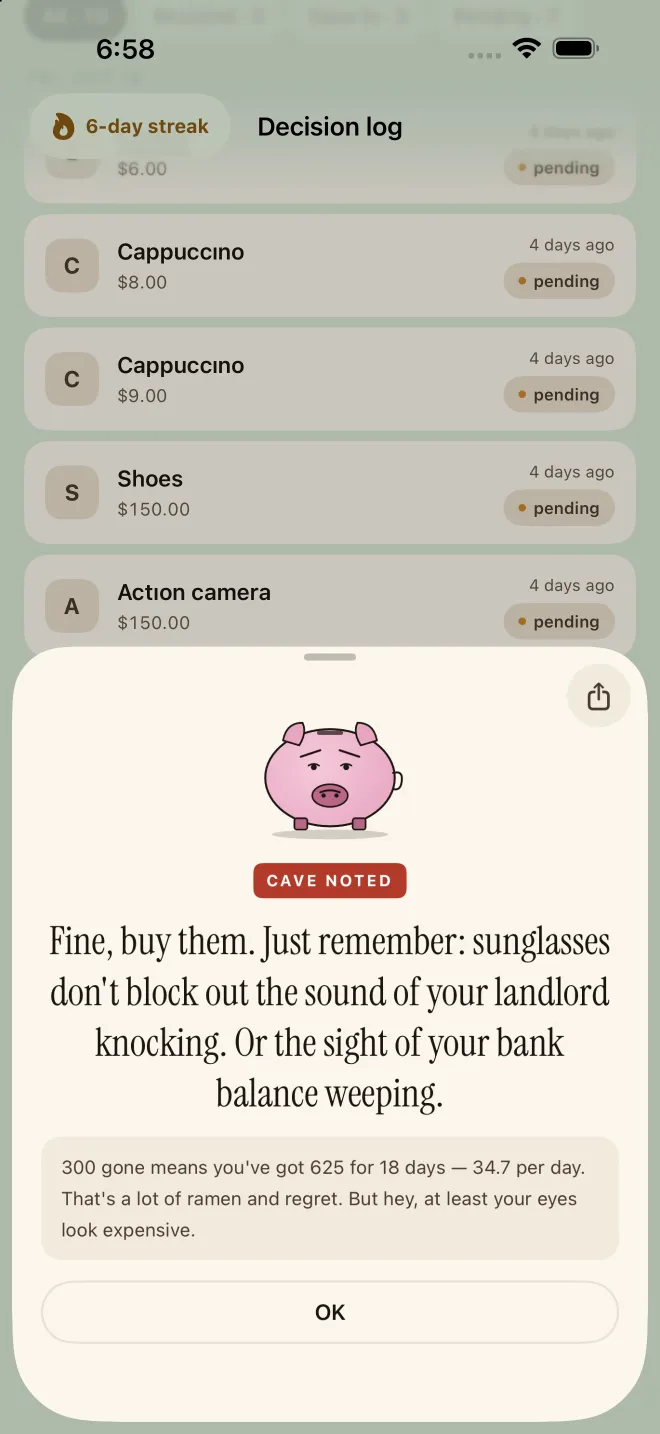
Next Paycheck is a spending journal with an opinion. Every ask is logged automatically.
- Ask before you buyType what you want and the price the moment the urge hits. That's your journal entry, done.
- Log the outcomeSwipe or tap Resisted or Gave in. Pending asks wait for you, and a follow-up reminder nudges you to answer.
- See the money you keptEvery resisted ask adds up as money avoided, shown in Settings.
- Review the Decision logWith NextPaycheck+, the Decision log shows every ask by day, your resisted and gave-in counts, and the total saved.
Frequently asked questions
How long should I keep an impulse spending journal?
Two to four weeks is usually enough to see patterns: the days, times and moods that lead to most of your impulse buys. Some people keep a lighter version going after that, logging only the urges they resisted.
Should I log urges I didn't act on?
Yes, and they're the most valuable entries. Every resisted urge is money you kept, and it shows you which triggers you can already handle.
Is a spending journal the same as a budget?
No. A budget plans where money should go; a spending journal records what actually happened and why. They work well together: the journal shows you the leaks the budget needs to plug.
Sources & further reading
- Spending tracker (Your Money, Your Goals) — Consumer Financial Protection Bureau
- Implementation intentions and goal achievement: a meta-analysis (Gollwitzer & Sheeran) — Advances in Experimental Social Psychology, 2006
Next Paycheck is a budgeting and spending-accountability tool, not a bank or a financial adviser. This page is general information for educational purposes, not financial, legal or tax advice: your situation is your own, so consider a qualified professional before major money decisions. If debt feels unmanageable, a nonprofit credit counselor can help, and if shopping feels out of control or is causing you distress, it is worth talking to a doctor or mental health professional.