Template
Paycheck budget template: a free printable for weekly, biweekly and monthly pay
Monthly budgets assume your money arrives monthly. For most people it doesn't. Budgeting one paycheck at a time matches how money actually lands in your account.
Quick answer
A paycheck budget plans one paycheck at a time. For each paycheck, write down the amount, every bill due before your next payday, what you'll save, and what's left to spend, then divide the leftover by the days until the next check. Start a fresh sheet every payday. It works for weekly, biweekly and monthly pay.
Most budgeting advice is built around a calendar month: income at the top, bills underneath. That's fine if you're paid once a month. If you're paid weekly or every two weeks, a monthly budget asks you to plan with money that hasn't arrived yet, which is how the rent ends up competing with last weekend's takeout.
And most employers don't pay monthly. In 2023 Bureau of Labor Statistics data, 43% of private businesses paid every two weeks, 27% weekly and about 20% twice a month; only about 10% paid monthly.
A paycheck budget fixes that by asking a simpler question every payday: which bills does this paycheck have to cover before the next one arrives?
How paycheck budgeting works
- Write down the paycheck amount and the date of the next one.
- List the bills due before the next paycheck, with due dates. Only these come out of this check.
- Set aside a slice of the big ones. If rent is due once a month and you're paid weekly, put a quarter of it aside from every check.
- Pay yourself. Decide what goes to savings or debt, even if it's small.
- What's left is spending money. Divide it by the days until payday for a daily limit.
Printable paycheck budget worksheet
One sheet per paycheck. Fill it in on payday, before you spend anything.
| Pay date | |
|---|---|
| Next pay date | |
| Days until next paycheck | |
| Paycheck amount (A) |
Bills due before the next paycheck
| Bill | Due date | Amount | Paid ✓ |
|---|---|---|---|
| Rent / mortgage (or this check's share) | |||
| Utilities | |||
| Phone & internet | |||
| Transport / car | |||
| Insurance | |||
| Debt payments | |||
| Subscriptions | |||
| Groceries | |||
| Total bills (B) |
The bottom line
| Savings or extra debt payment (C) | |
|---|---|
| Left to spend: A − B − C | |
| Per day: left to spend ÷ days |
Example: a biweekly paycheck
Alex is paid $1,400 every two weeks. This paycheck lands on the 1st; the next one on the 15th.
| Item | Due | Amount |
|---|---|---|
| Rent | 1st | $750 |
| Phone | 8th | $45 |
| Car insurance | 10th | $110 |
| Groceries (two weeks) | — | $180 |
| Streaming subscriptions | 12th | $25 |
| Bills before the 15th | $1,110 | |
| Savings | $60 | |
| Left to spend | $230 | |
| Per day (14 days) | about $16 |
On the 15th, Alex starts a new sheet, and that paycheck covers the bills due before the 29th. Rent isn't on it, so there's more room, which is exactly where the savings for next month's rent can come from.
Weekly pay with monthly bills
Weekly pay is the trickiest, because most big bills are monthly. The simplest fix is to divide each monthly bill by four (or by the number of paychecks before it's due) and set that much aside from every weekly check. Our answer on how to budget a weekly paycheck walks through it.
Biweekly pay: the two "extra" paychecks
Every two weeks means 26 paychecks a year, not 24. So twice a year, a month has three paydays. Because your monthly bills are usually covered by the other two, the third paycheck is the easiest money you'll ever get to save: an emergency fund, a debt payment, or a yearly bill you'd otherwise scramble for.
Budget by paycheck in Next Paycheck
- Pick your pay scheduleWeekly, every two weeks or monthly, and your payday. Cycles roll forward on their own.
- Add your bills with due datesWeekly, monthly, quarterly or yearly. Only the bills due before your next paycheck count against this one.
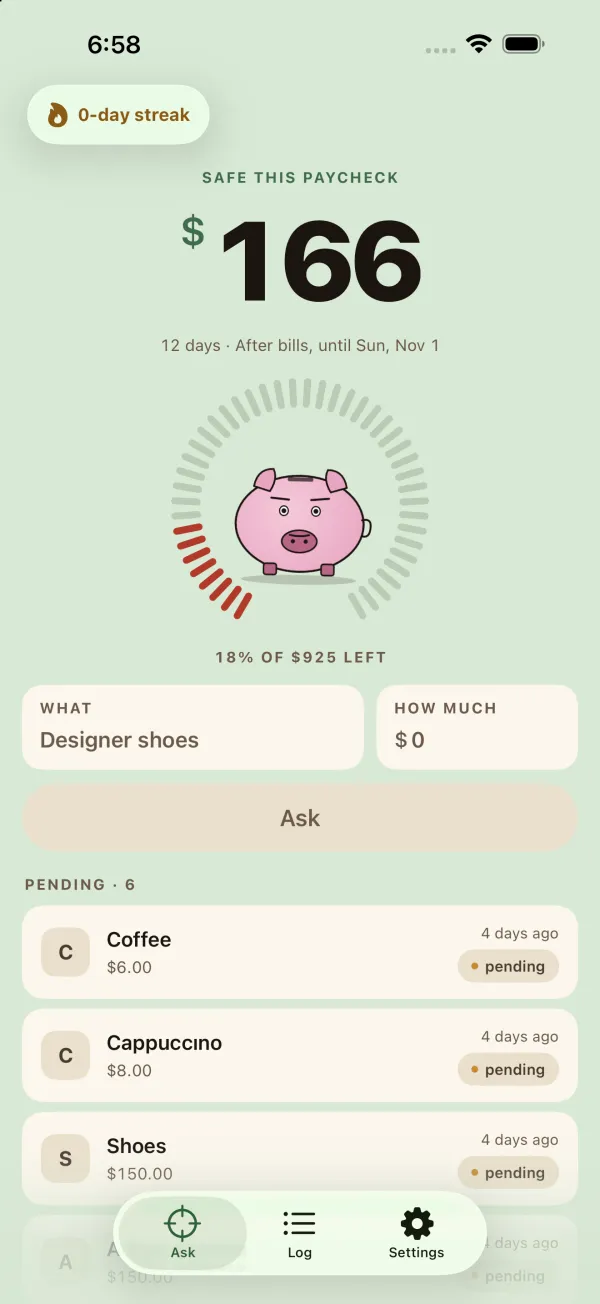
- See what's safe this paycheckThe home screen shows the amount after bills, how many days it has to last, and how much is left on the dial.
- Check purchases against itAsk Pork before you buy, and anything you give in on comes off the number straight away.
Frequently asked questions
Should I use a monthly budget or a paycheck budget?
If you're paid monthly, they're the same thing. If you're paid weekly or every two weeks, a paycheck budget is usually easier to follow, because each plan covers exactly the money you have and the bills due before more arrives.
What if I'm paid twice a month on set dates?
That's semimonthly pay (say the 1st and the 15th), and the worksheet works the same way: list the bills due before the next pay date. Next Paycheck itself supports weekly, every-two-weeks and monthly pay; semimonthly isn't available in the app yet.
What do I do with a third paycheck in a month?
With biweekly pay you get 26 paychecks a year, so two months have three. Since your monthly bills are usually covered by the other two, the third is a good moment to build savings or cover a yearly bill.
Sources & further reading
- Length of pay periods in the Current Employment Statistics survey — U.S. Bureau of Labor Statistics
- Bill calendar (Your Money, Your Goals) — Consumer Financial Protection Bureau
- Spending tracker (Your Money, Your Goals) — Consumer Financial Protection Bureau
Next Paycheck is a budgeting and spending-accountability tool, not a bank or a financial adviser. This page is general information for educational purposes, not financial, legal or tax advice: your situation is your own, so consider a qualified professional before major money decisions. If debt feels unmanageable, a nonprofit credit counselor can help, and if shopping feels out of control or is causing you distress, it is worth talking to a doctor or mental health professional.