
Calculator
Price to hours worked calculator: how many hours of work is it?
$89 doesn't sound like much. Most of a day's work sounds like a lot. Translating prices into hours is one of the fastest ways to cool off an impulse.
Quick answer
Hours of work = price ÷ your take-home pay per hour. To find your take-home hourly rate, divide one paycheck (after taxes) by the hours you worked to earn it. If you take home $1,400 for 80 hours, that's $17.50 an hour, so an $89 purchase costs about 5 hours of work.
Price to hours worked calculator
5.1 hours
at a take-home rate of $17.50 an hour
That's about 0.6 of an 8-hour work day.
Full-time, paid every two weeks? That's usually about 80 hours. Weekly: about 40.
{hours} hour
{hours} hours
at a take-home rate of {rate} an hour
Enter your take-home paycheck and hours.
That’s about {days} of an 8-hour work day.
That’s about {days} full 8-hour work days.
Why thinking in hours works
Prices are abstract, especially on a screen. Hours are not: you remember exactly what a long Tuesday felt like. Translating "$89" into "most of a day at work" brings the real cost into the moment of decision, which is precisely when impulse buys slip through. The idea has been popular in personal finance for decades, and it's one of the simplest reframes there is.
Find your real hourly rate
- Start with one paycheck, the amount that actually lands in your account.
- Count the hours you worked to earn it. For salaried jobs, use your typical hours, not the contract's 40.
- For the honest version, add commute time and subtract work costs like transit, parking or work clothes.
- Divide. That's what an hour of your life is worth in spending money.
A few everyday translations
At a take-home rate of $17.50 an hour:
| Purchase | Price | Hours of work |
|---|---|---|
| Daily café latte, for a month | $130 | about 7.4 |
| Takeout twice a week, for a month | $240 | about 13.7 |
| Sneakers "on sale" | $150 | about 8.6 |
| New phone | $1,000 | about 57 |
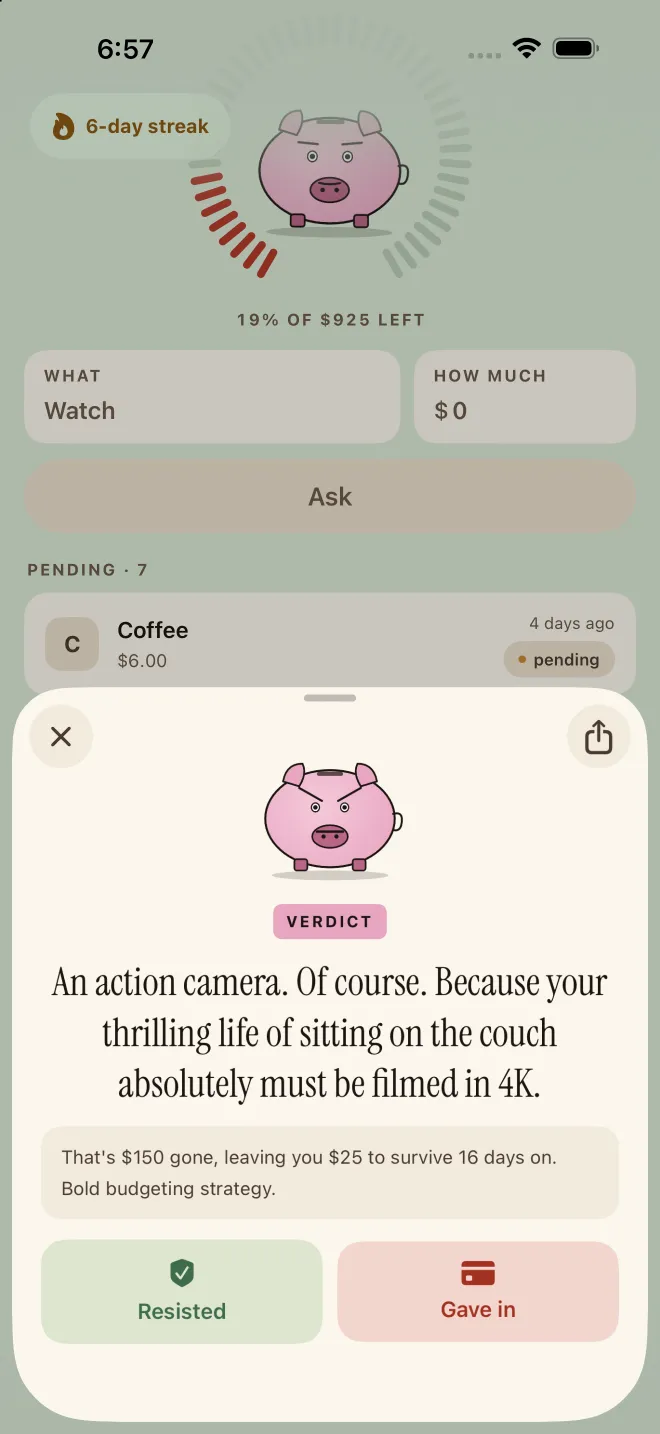
Get a second opinion from Pork
- Set your paycheck onceNext Paycheck knows your take-home pay, your pay schedule and your bills.
- Ask before you buyType the thing and the price. Pork compares it with what's safe to spend this paycheck and roasts the idea.
- Keep scoreEvery resisted ask is added to the money you've avoided, which is a lot of hours you didn't give away.
Frequently asked questions
Should I use my salary or my take-home pay?
Take-home pay. It's the money that actually reaches your account after taxes and deductions, so it's what you really spend. Using gross pay makes everything look cheaper than it is.
What about the time I spend commuting?
If you want the honest version, add your commute and any unpaid work time to the hours, and subtract work costs like transit or parking from your pay. Your true hourly rate is often noticeably lower than your official one.
Doesn't this make every purchase feel bad?
It shouldn't. Plenty of things are worth a few hours of work. The point is to make the trade-off visible for the purchases you'd otherwise make on autopilot.
Next Paycheck is a budgeting and spending-accountability tool, not a bank or a financial adviser. This page is general information for educational purposes, not financial, legal or tax advice: your situation is your own, so consider a qualified professional before major money decisions. If debt feels unmanageable, a nonprofit credit counselor can help, and if shopping feels out of control or is causing you distress, it is worth talking to a doctor or mental health professional.