
Waiting rules
The 24-hour rule for shopping, and when to use the 72-hour or 30-day rule
Most impulse buys don't survive a night's sleep. Waiting rules turn that into a system: here's how the 24-hour, 72-hour and 30-day rules work, and which to use when.
Quick answer
The 24-hour rule means that when you want to buy something you didn't plan for, you wait 24 hours before buying it. If you still want it tomorrow and it fits your budget, you buy it guilt-free. Many urges fade overnight. For bigger purchases, people use a 72-hour rule (three days) or a 30-day rule, writing the item on a list and deciding when the time is up.
Impulse buying lives in a very short window: the few seconds between "I want that" and tapping Buy. Retailers know it, which is why checkout is one tap, the timer is counting down and the card is already saved. Waiting rules work because they stretch that window from seconds to hours or days, long enough for the excitement to fade and your actual priorities to catch up.
How the 24-hour rule works
- Notice the urge. Anything you didn't plan to buy today counts.
- Don't buy it now. Write it down, save it to a list, or leave it in the cart.
- Wait 24 hours. Close the tab, put the phone down, sleep on it.
- Decide with fresh eyes. Do you still want it? Can you afford it after the bills due before payday? Would you rather have the money?
- Buy it, or let it go. Either way, you made a decision instead of an impulse.
24 hours, 72 hours or 30 days?
| Rule | Best for | Why |
|---|---|---|
| 24-hour rule | Small and everyday impulses: clothes, gadgets under $100, "just one more" orders | Long enough for a mood-driven urge to pass, short enough to actually follow |
| 72-hour rule | Medium purchases, or anything bought late at night or after a bad day | Three days takes you past the emotion and into a normal day or two |
| 30-day rule | Big, non-essential purchases: a new phone, furniture, a pricey hobby | A month shows whether you want the thing or the feeling of buying it |
A simple way to choose: the bigger the price, or the stronger the emotion behind the urge, the longer the wait.
Even the law recognizes the value of a pause: the FTC's Cooling-Off Rule gives you three business days to cancel certain sales made at your home or at temporary locations like fairs, though it doesn't cover online orders.
Why waiting works
- Feelings fade faster than wants. A lot of impulse buying is about changing a mood: bored, stressed, tired, celebrating. By tomorrow the mood has moved on, and so has the urge.
- The sales pressure expires. "Only 2 left" and "sale ends tonight" are designed to stop you thinking. Waiting is how you start thinking again.
- It's what works for other people. In a 2019 study of online impulse buyers by University of Michigan researchers, postponing (sleeping on it, leaving items in the cart) was one of the most common strategies that worked, while willpower alone was only ever described as failing.
- You compare it with real numbers. With time to check, a $60 purchase gets compared with what's actually left until payday, not with your balance on payday.
Printable 30-day wish list
Write down anything you want but didn't plan for. Check back on the decide-by date.
| Date | Item | Price | Why I want it | Wait | Decide by | Still want it? |
|---|---|---|---|---|---|---|
| Mar 3 | Wireless earbuds | $89 | Mine are fine, saw an ad | 72 h | Mar 6 | No |
Add up the "No" rows at the end of the month. That's money you kept just by waiting.
Making the rule stick
- Make it the default. Decide once that every unplanned purchase gets a wait, so you're not negotiating with yourself each time.
- Remove instant checkout. Delete saved cards and log out of stores, so buying takes effort.
- Set a reminder for the decide-by time, so the wait ends in a decision, not a forgotten tab that you reopen at midnight.
- Count your wins. Keeping track of what you didn't buy makes the rule feel like saving, not missing out.
Use Next Paycheck as your waiting rule
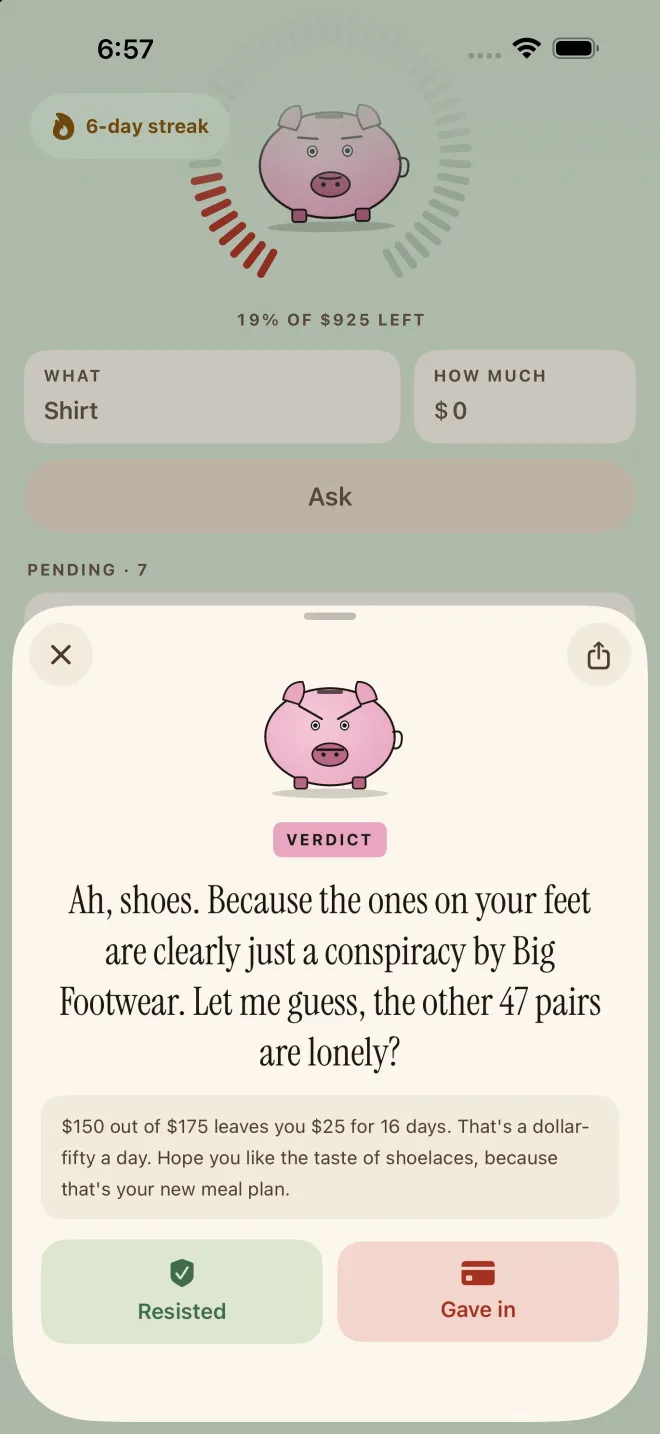
- Ask Pork the moment you want itType what you want and the price. Pork checks it against what's safe to spend until payday and turns it down with a roast.
- Set your waiting periodIn Settings, choose how long Pork waits before following up on your most recent ask: anywhere from 1 hour to 72. Set it to 24 for the 24-hour rule, or 72 for the 72-hour rule.
- Answer the follow-upWhen it arrives ("Be honest. Did you cave on it yet?"), tap through to the verdict and log what happened.
- Count what you keptEvery Resisted adds the price to the money you've avoided, and your streak keeps counting the days since you last gave in.
Frequently asked questions
Does the 24-hour rule work for online shopping?
It works especially well online, because the item will still be there tomorrow. Leave it in the cart or on a list, close the tab, and come back after the waiting period. Some stores even email a discount to abandoned carts, so waiting can save money twice.
What if the item sells out while I wait?
For most impulse buys, that's a feature, not a bug. If something genuinely can't wait, like a limited ticket you'd already planned for, it probably wasn't an impulse buy in the first place.
Should I use the 30-day rule for everything?
No. Thirty days is for big or non-essential purchases. Applying it to everything makes the rule annoying enough to abandon. Match the wait to the price: a day for small things, a few days for medium ones, a month for the big stuff.
Sources & further reading
- Impulse buying: design practices and consumer needs (Moser, Schoenebeck & Resnick) — ACM CHI Conference, 2019
- Buyer's remorse: the FTC's Cooling-Off Rule may help — Federal Trade Commission
Next Paycheck is a budgeting and spending-accountability tool, not a bank or a financial adviser. This page is general information for educational purposes, not financial, legal or tax advice: your situation is your own, so consider a qualified professional before major money decisions. If debt feels unmanageable, a nonprofit credit counselor can help, and if shopping feels out of control or is causing you distress, it is worth talking to a doctor or mental health professional.