Calculator
How much can I spend until payday? Safe-to-spend calculator
Your balance after payday is lying to you: half of it already belongs to rent. Here's the number that's actually yours to spend, worked out in seconds.
Quick answer
To work out how much you can spend until payday: take the money you have now, subtract every bill due before your next paycheck and anything you're setting aside, then divide what's left by the days until payday. That's your safe-to-spend amount and your daily limit. Check it before any purchase you didn't plan for.
Safe-to-spend calculator
Change any number and the result updates. Nothing you type leaves this page.
$166.00
safe to spend until payday
$13.83 a day for 12 days
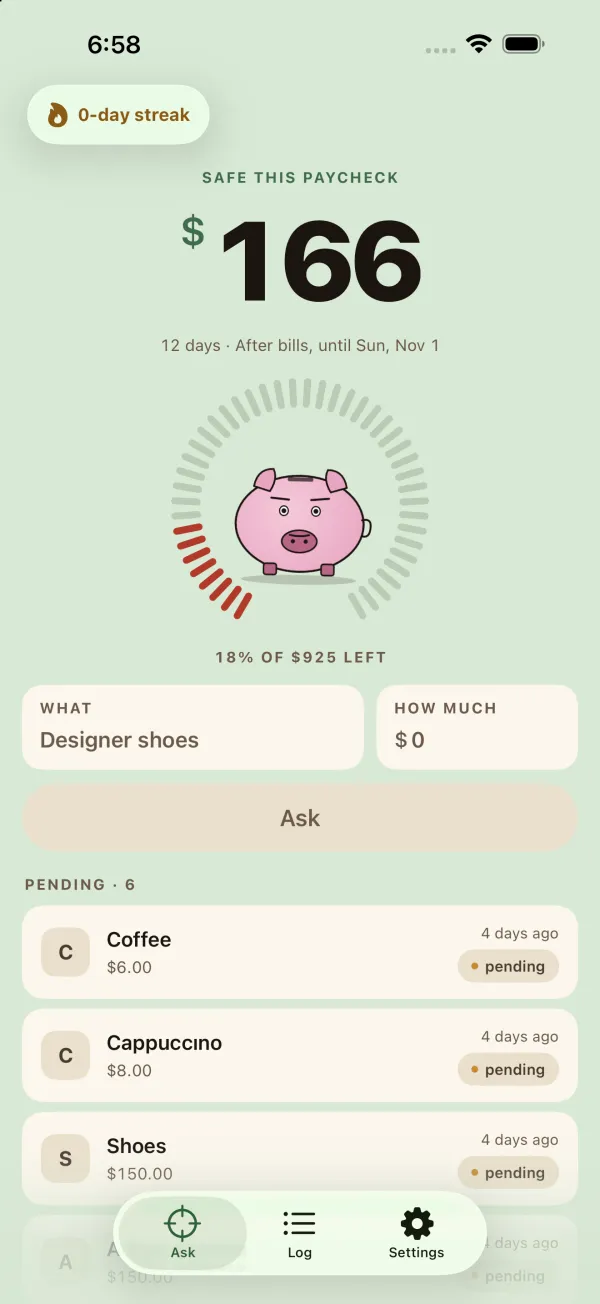
The default numbers match the Next Paycheck screenshot further down this page: a $925 paycheck, $759 of bills before payday, 12 days to go.
safe to spend until payday
short before payday
{perday} a day for 1 day
{perday} a day for {days} days
{perday} a day for {days} days ({perweek} a week)
Your bills and savings add up to more than you have. See "What if the number is negative?" below.
After a {price} purchase you’d have {left} left, or {perday} a day.
A {price} purchase would put you {over} over before payday.
The safe-to-spend formula
Here's the whole thing:
Safe to spend = money you have now − bills due before payday − money you're setting aside. Daily limit = safe to spend ÷ days until payday.
Using the numbers above: $925 − $759 − $0 = $166 safe to spend. With 12 days to go, that's about $13.83 a day. Suddenly a $45 "treat" looks less like a treat and more like three days of lunch.
The trick is the middle part. On payday your balance includes money that's already spoken for: rent next week, the phone bill on the 20th, the car insurance that comes out the day before your next check. Spend from the balance, and you're spending your bills. Spend from the safe number, and you're spending only what's actually yours.
What counts as a bill before payday
Anything you'll have to pay before your next paycheck arrives, whether or not it has already left your account:
- Housing: rent or mortgage, if it falls in this pay period
- Utilities and connectivity: power, water, gas, phone, internet
- Debt payments: at least the minimum on every card or loan
- Insurance, transport and childcare due this period
- Subscriptions that renew before payday
- Groceries, if you treat a set amount as non-negotiable
- A slice of big irregular bills, like a yearly insurance premium divided across your paychecks
If you're paid weekly or every two weeks, not every monthly bill lands in every pay period. That's the point: count only the ones due before the next check. Our paycheck budget template shows how to match bills to paychecks.
How to make your paycheck last until the next one
- Move the bill money first. On payday, set aside everything due before the next check, so it's out of sight.
- Know your daily number. A daily limit is easier to stick to than a monthly one, because you can see it running out.
- Check before you buy, not after. Before any unplanned purchase, compare the price with your daily limit. This is the moment most overspending happens.
- Give purchases a cooling-off period. A 24-hour rule catches most impulse buys without banning anything.
- Plan a few no-spend days. They stretch the money and reset the habit. See the no-spend challenge.
What if the number is negative?
If your bills before payday are bigger than the money you have, you're not alone: in the Federal Reserve's latest survey of household finances, 37% of adults said they wouldn't cover a surprise $400 expense entirely with cash or its equivalent. And it's better to know now than on the day a payment bounces. Some steps that usually help:
- Cover the essentials first: housing, utilities, food, transport to work, and minimum debt payments.
- Call the companies you owe before the due date. Many will move a date or set up a payment plan if you ask early; the CFPB suggests asking to move a due date to a week when you have more money.
- Pause everything optional until payday: subscriptions you can skip, takeout, unplanned shopping.
- Be wary of high-cost borrowing such as payday loans, which can make the next paycheck shorter still. Even credit cards are expensive: the average bank card interest rate was over 21% in 2026, according to the Federal Reserve.
If it keeps happening, a nonprofit credit counselor can help you look at the bigger picture for free or at low cost.
Let Next Paycheck work it out
Next Paycheck runs this exact calculation for you, all paycheck long, and checks every purchase you're tempted by against it.
- Add your paycheckWeekly, every two weeks or monthly, plus your payday.
- Add your fixed billsFrom 11 presets or your own, with how often they're due and the next due date.
- Read your safe numberThe home screen shows what's safe this paycheck after the bills due before payday, how many days it has to last, and a dial of how much is left.
- Ask before you buyType the thing and the price. Pork checks it against your safe number and, in Comedian mode, usually tells you what it would leave you per day.
- Log what you didGave in? It comes straight off your safe number. Resisted? It's added to the money you've avoided.
Frequently asked questions
Should groceries count as a bill?
If you'd buy them no matter what, yes. Many people treat a set grocery amount for the pay period as a fixed bill, so the safe-to-spend number covers only the extras. If your grocery spending swings a lot, set aside your usual amount and adjust.
What if my paycheck changes every time?
Use the amount you actually received, not the one you hope for. With irregular pay it helps to plan around your lowest typical paycheck and treat anything above it as a bonus for savings or upcoming bills.
What's a good daily spending limit?
There isn't a universal number: it's whatever is left after bills and savings, divided by the days until payday. The useful part is knowing it before you buy, so a $40 impulse can be compared with a $14-a-day budget.
Sources & further reading
- Bill calendar (Your Money, Your Goals) — Consumer Financial Protection Bureau
- Economic Well-Being of U.S. Households in 2025 — Federal Reserve Board, 2026
- Consumer credit G.19: interest rates on credit card plans — Federal Reserve Board
- An essential guide to building an emergency fund — Consumer Financial Protection Bureau
Next Paycheck is a budgeting and spending-accountability tool, not a bank or a financial adviser. This page is general information for educational purposes, not financial, legal or tax advice: your situation is your own, so consider a qualified professional before major money decisions. If debt feels unmanageable, a nonprofit credit counselor can help, and if shopping feels out of control or is causing you distress, it is worth talking to a doctor or mental health professional.