
How-to
How to stop online shopping: 12 ways to break the add-to-cart habit
Online stores are built to remove every second of hesitation. Breaking the habit means putting those seconds back, deliberately, in the places that matter.
Quick answer
To stop online shopping, add friction where the habit lives: delete saved cards, log out of stores, delete or hide shopping apps, unsubscribe from store emails and turn off shopping notifications. Then put a pause before every unplanned order (a 24-hour wish list works well), give yourself a small planned budget for fun purchases, and keep track of what you resisted so the money you kept is visible.
Online shopping isn't a willpower problem you happen to have. It's an environment designed to remove every moment where you might reconsider: the card is saved, checkout is one tap, the app pings you about a sale, and the feed you opened to see friends' photos is also a store. Changing the environment works far better than promising yourself to be stronger.
12 ways to stop online shopping
Remove the shortcuts
- Delete saved payment methods from stores and browsers. Typing a card number is a surprisingly effective pause.
- Log out of shopping sites and apps, every time.
- Delete shopping apps, or at least move them off your home screen into a folder you have to search for.
- Turn off one-tap ordering features where they exist.
Cut the triggers
- Unsubscribe from store emails. Every "sale ends tonight" is an invitation.
- Turn off shopping notifications, including "price drop" and "back in stock" alerts.
- Unfollow and mute haul accounts, deal pages and influencers you mainly follow for products.
- Notice your danger times. For many people it's late at night or right after payday. See how to stop impulse buying at night.
Add a pause
- Use a wish list, not a cart. Anything unplanned waits 24 hours, or longer for big things. That's the 24-hour rule.
- Skip "pay later" for wants. Splitting a price into small installments makes it feel cheaper than it is, and installments can stack up: the CFPB found that about 63% of pay-in-four borrowers had more than one loan at the same time at some point, and about one in ten users was charged a late fee in 2021.
Replace the habit
- Plan a small "fun money" budget each paycheck, so wanting something isn't forbidden, just scheduled.
- Track what you didn't buy. A running total of resisted purchases turns "missing out" into "money kept". A spending journal helps.
Platform by platform
| Where | What gets you | What helps |
|---|---|---|
| Amazon | Saved cards, fast delivery, "frequently bought together" | Remove saved cards, use lists instead of the cart, review subscriptions you've forgotten |
| TikTok Shop | Products inside entertaining videos, live-stream countdowns | Don't buy during a live stream; screenshot it and wait a day |
| Shoppable posts and targeted ads in your feed | Mute or unfollow shopping-heavy accounts, hide ads you keep clicking | |
| Deal apps | Gamified discounts, spins, "only today" prices | Delete them; a deal on something you didn't need isn't a saving |
When it's more than a habit
For some people, shopping stops being a habit and becomes something that feels out of control: buying to cope with painful feelings, hiding purchases, feeling unable to stop, running up debt. That's sometimes called compulsive buying. One U.S. study estimated that around 6% of adults show signs of it; it isn't listed as its own diagnosis in the DSM-5, but it's still worth talking to a doctor, therapist or counselor about. There's nothing embarrassing about getting help with it.
Put Pork between the cart and checkout
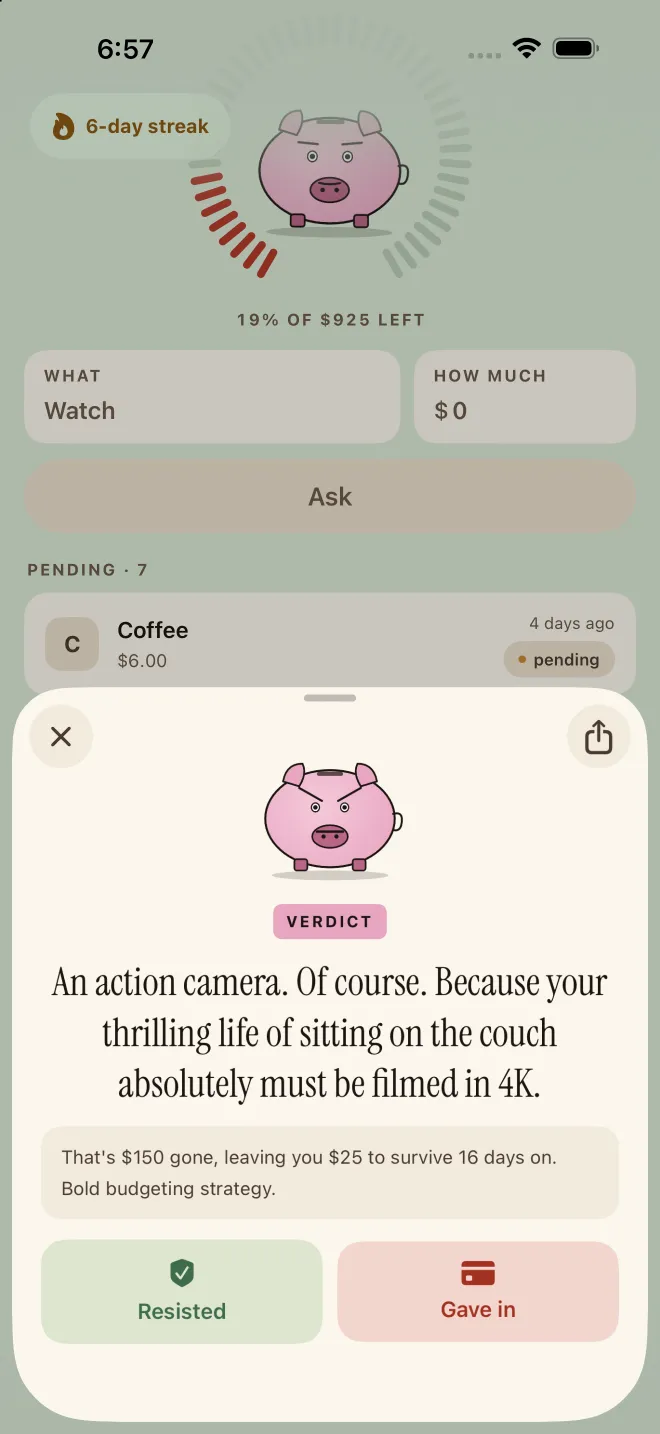
- Make it the ruleNothing unplanned gets bought until you've asked Pork.
- Ask with the priceType what's in your cart and the total. Pork checks it against what's safe to spend until payday and turns it down.
- Close the tab, log the resultResisted adds to your money-avoided total. Gave in comes off what's left this paycheck.
- Let the follow-up catch the comebackHours later, Pork asks whether you caved. Usually, by then, you don't want it any more.
Frequently asked questions
Is there an app to stop online shopping?
There are a few approaches: site blockers that stop you visiting stores, browser extensions that add a delay, and accountability apps like Next Paycheck, where you ask an AI coach before buying. The best one is the one you'll actually use at the moment of temptation.
Why can't I stop shopping online?
Because it's designed to be effortless: saved cards, one-tap checkout, constant notifications and personalized feeds. Add stress or boredom, and buying becomes a quick mood fix. That's a habit, and habits respond to changing the environment more than to willpower.
When is online shopping a problem worth getting help for?
If you feel unable to stop, shop to cope with difficult feelings, hide purchases, or it's causing debt or conflict, it may be compulsive buying. A doctor, therapist or counselor can help, and you don't have to wait for it to get worse.
Sources & further reading
- Research reveals heavy buy now, pay later use among borrowers with high credit balances — Consumer Financial Protection Bureau, 2025
- Study details the rapid growth of buy now, pay later lending — Consumer Financial Protection Bureau, 2022
- Impulse buying: design practices and consumer needs (Moser, Schoenebeck & Resnick) — ACM CHI Conference, 2019
- Estimated prevalence of compulsive buying behavior in the United States (Koran et al.) — American Journal of Psychiatry, 2006
- Should compulsive buying-shopping disorder be classified as a behavioral addiction? (Müller et al.) — Journal of Behavioral Addictions, 2021
Next Paycheck is a budgeting and spending-accountability tool, not a bank or a financial adviser. This page is general information for educational purposes, not financial, legal or tax advice: your situation is your own, so consider a qualified professional before major money decisions. If debt feels unmanageable, a nonprofit credit counselor can help, and if shopping feels out of control or is causing you distress, it is worth talking to a doctor or mental health professional.