Challenge
No-spend challenge: the rules, a free printable tracker, and how to keep the streak
Thirty days of spending on nothing but the essentials sounds simple until day four, when the sale email arrives. Here's how to set it up so it survives day four.
Quick answer
A no-spend challenge is a set period, often a weekend, a week or 30 days, when you spend money only on essentials: bills, groceries on a list, medicine and getting to work. Everything else (takeout, clothes, gadgets, online shopping) waits until the challenge ends. Decide your rules and exceptions before you start, track every day, and if you slip, mark it and keep going.
The appeal of a no-spend challenge is how simple it is. You're not building a budget, categorizing transactions or setting up spreadsheets. You're just not buying stuff for a while, and paying attention to what happens when you don't.
What usually happens is enlightening. Most people discover that a big share of their spending was on autopilot: the coffee on the way in, the "it was on sale" order, the delivery after a long day. Remove it for a month and you find out which of those you actually missed.
No-spend challenge rules
- Pick a length and put the start and end dates on a calendar.
- Write your essentials list. These are allowed: rent or mortgage, utilities, phone, minimum debt payments, insurance, transport to work, medicine, and groceries from a list.
- Write your "not allowed" list. Be specific about your own weak spots: takeout, coffee shops, clothes, beauty, gadgets, apps and games, impulse online orders.
- Decide the exceptions now, not in the moment: a friend's birthday gift, a planned trip, something that breaks and must be replaced.
- Track every day. A no-spend day gets a mark. A spending day gets a different mark and a one-line note on what happened.
- If you slip, keep going. One bad day isn't a reason to abandon the other twenty-nine.
| Usually allowed | Usually not allowed |
|---|---|
| Rent, mortgage and utilities | Takeout and food delivery |
| Groceries from a list | Coffee shops and snacks out |
| Phone, internet, insurance | Clothes, shoes and accessories |
| Minimum debt payments | Gadgets, home decor, hobbies gear |
| Gas or transit to work | Online shopping and "add to cart" |
| Medicine and health costs | New subscriptions and in-app purchases |
How long should a no-spend challenge be?
- A no-spend weekend: a good first try. Weekends are when a lot of casual spending happens.
- A no-spend week: long enough to hit a few triggers, short enough to stay motivated.
- 30 days: the classic. Long enough to break autopilot habits and see a real difference in your balance.
- Longer: if a month went well, a low-buy year keeps the benefits without the strictness.
Printable 30-day no-spend challenge tracker
Cross out each no-spend day. Circle any day you spent outside your essentials and write one word about why.
Start date: ____________ End date: ____________ Why I'm doing this: ______________________________
My allowed list
- Rent / mortgage
- Utilities & phone
- Groceries (from the list)
- Transport to work
- Medicine
- Minimum debt payments
My weak spots (not allowed)
- ______________________
- ______________________
- ______________________
- ______________________
Tips to make it stick
- Remove the triggers before day one. Unsubscribe from store emails, delete shopping apps, and turn off sale notifications.
- Plan the food. A meal plan and a grocery list stop the "nothing to eat, let's order" spiral.
- Find free things to do for the times you'd normally shop out of boredom: a walk, the library, a free event.
- Tell someone. Saying it out loud, or having someone (or something) to check with before you buy, makes it harder to quietly cave.
- Make the savings visible. Each evening, note what you would have spent. Watching that number grow is half the motivation.
What to do with the money you didn't spend
Decide this before you start, or the money tends to disappear on day 31. Good homes for it: an emergency fund, a high-interest debt payment, or a goal you actually care about. Moving it on the last day of the challenge makes the win concrete. After that, the CFPB suggests saving a set amount every payday, ideally automatically, which is an easy habit to start with your no-spend savings.
Run your no-spend challenge in Next Paycheck
- Set up onceAdd your paycheck and fixed bills, so your essentials are already accounted for in your safe-to-spend number.
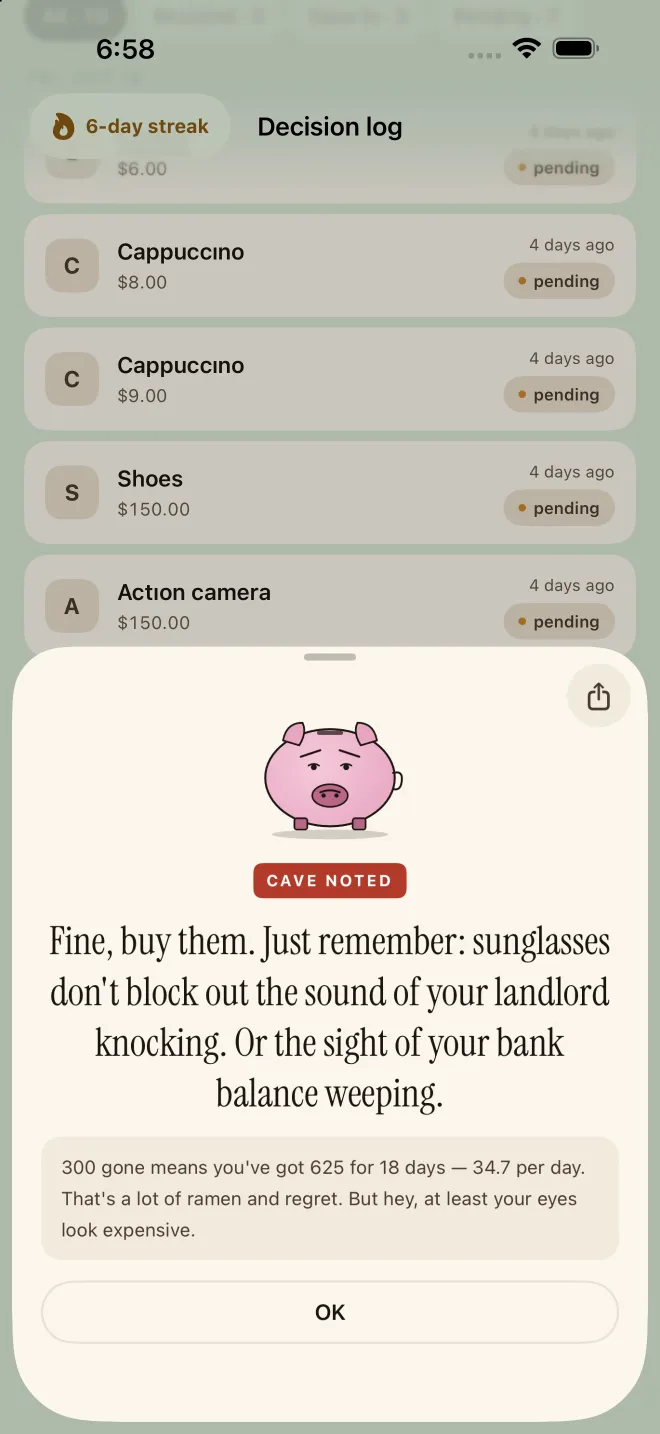
- Ask Pork when you're temptedType the thing and the price. Pork turns it down, loudly, which is exactly what day four needs.
- Log it honestlyTap Resisted if you walked away: it's added to the money you've avoided. Tap Gave in if you didn't.
- Watch the streakYour streak counts the days since you last gave in. The Settings tile shows it for free; NextPaycheck+ adds the streak chip and the full Decision log.
- Let the follow-up catch youA few hours after an ask (1 to 72, your choice), Pork checks in: did you cave yet?
Frequently asked questions
Can I buy groceries on a no-spend challenge?
Yes. Groceries, bills, medicine and getting to work are essentials, so they're allowed. Most people write a grocery list before the challenge starts and stick to it, which keeps "groceries" from turning into snacks and kitchen gadgets.
What if I break my no-spend challenge?
Mark the day, note what triggered it, and keep going. One slip doesn't undo the other days, and the note about what tempted you is often the most useful thing the challenge produces.
Does a no-spend challenge work?
It works best as a reset rather than a permanent rule: a short stretch that shows you where your money goes, which purchases you don't miss, and which triggers get you. The lasting win is the habit of pausing before you buy, not the 30 days themselves.
Sources & further reading
- Spending tracker (Your Money, Your Goals) — Consumer Financial Protection Bureau
- An essential guide to building an emergency fund — Consumer Financial Protection Bureau
Next Paycheck is a budgeting and spending-accountability tool, not a bank or a financial adviser. This page is general information for educational purposes, not financial, legal or tax advice: your situation is your own, so consider a qualified professional before major money decisions. If debt feels unmanageable, a nonprofit credit counselor can help, and if shopping feels out of control or is causing you distress, it is worth talking to a doctor or mental health professional.